Slow or Stuck
Two words that look identical from inside a Tuesday
↪ 7 min read

I. A Whole Year in a Single Day
Some days around here go by like a year.
Nothing dramatic happens on those days: feedback comes in, revisions go out, and somebody's slack audio won't work. You look up at 4pm and you can't point to a single thing that moved. Somewhere in the middle of that, a simple but unnerving question shows up.
Does any of this even matter?
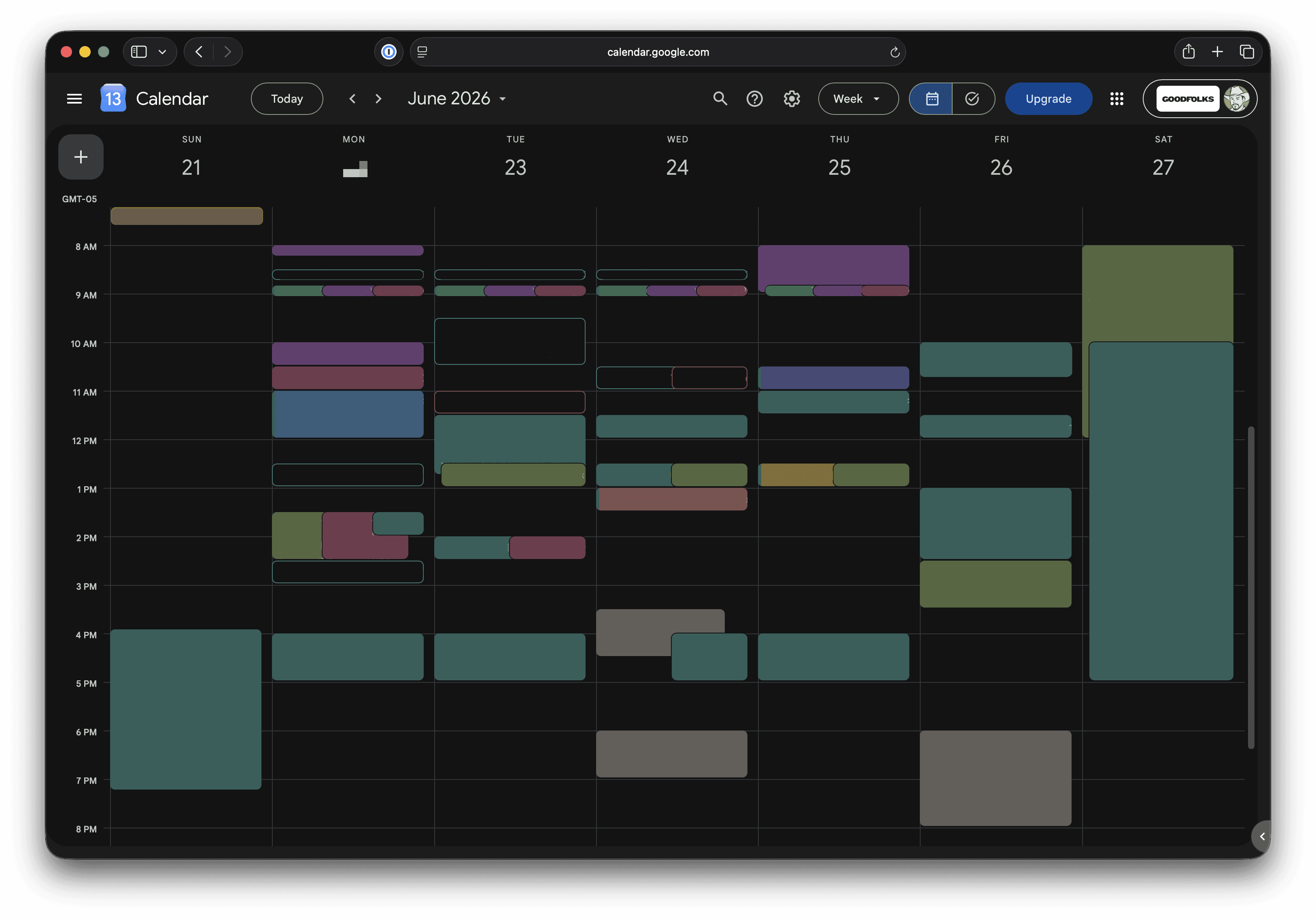
A pretty typical week around here
I've run GoodFolks for close to ten years and I've had a lot of those days. Enough of them that I eventually needed language for what I was afraid was happening on them. But like most things, getting to an answer started with a question.
Are we slow or are we stuck?
These days, what I've landed on, at least for now, is that slow is a pace and stuck is a direction.
A slow business is moving deliberately toward something, even when the movement is often too small to see. A stuck business is doing the same motions with nowhere left to go but calling it a plan. The scary part is that from inside a single day, they can look identical and even produce the exact same experience. Same inbox, same meetings, same 4pm.
I wish I could tell you I always know which one is playing out around here. I don't. I'm still somewhere on the road toward one and hopefully moving away from the other. Part of why I'm writing this is to figure out how anyone tells the difference at all.
The best answer I've found didn't come from business. It came from watching my girls grow up.
II. The Days are Long
Have you ever heard the saying "the days are long but the years are short"? If you're a parent you probably have. Every parent knows it's true.
Most days my daughters look the same as they did the day before. Same faces at breakfast, same arguments about shoes, same bedtime negotiations that could be entered into evidence in a court of law. Day to day, nothing changes.
Then one day you look over and there's pre-teens in your house. Whole inches appeared. Vocabularies showed up. Somebody learned to be sarcastic. None of it happened on a day I can name. But it all happened.
The truth is growth is real and constant and completely invisible most of the time. A day is simply the wrong instrument for measuring it, the way a ruler is the wrong instrument for weighing something. You can stare at a Tuesday as hard as you want but it'll never show you the year.
I'm starting to suspect that business works the same way. The version of GoodFolks that exists today is the sum of thousands of days that individually felt like they didn't matter. The clients who trust us today probably trust us because of little moments and promises we kept back in 2019 that nobody remembers making. The team leans on each other because of a hundred small favors that nobody wrote down. I can't point to the day any of it happened because it happened across all of them.
So when the year-in-a-day feeling hits and I catch myself asking whether any of this matters, the honest answer is usually that I'm measuring with the wrong instrument. Most days that thought is a comfort. But lately I've noticed it can also be a hiding place.
III. The Alibi
Here's what I mean.
"You can't see growth up close" is a true sentence, and it's also the perfect alibi. It's exactly the story a stuck thing tells itself. Trust the process, it's compounding, you just can't see it yet.
The problem is that stuck produces the same daily readout as slow. Same full calendar, same reasonable explanations, same nothing to show for today. If invisible progress and invisible non-progress feel identical from the inside, then telling myself to be patient settles nothing.
Meanwhile waiting for hindsight to sort it out has its own cost, because stuck compounds too. Habits harden, instincts dull, and the bar drops a little each year without anyone announcing it. By the time the years reveal the answer, it's already cost you.
So if the days can't tell you and you can't afford to wait for the years, what's left?
The closest thing I have to a real test goes back to pace versus direction. A slow business can tell you, plainly and specifically, what it's moving toward. A stuck one can only describe its routine, and gets a little defensive when you press on it.
It's a decent test. But I have to be honest about my record with it, because I've managed to get it wrong in both directions at the same time.
IV. Wrong Twice
For a long stretch, if you'd asked me which part of GoodFolks was stuck, I would have said our culture.
And yet, there was never really anything you could point at that our culture produced. There was never a moment where it visibly improved or an initiative behind it you could name. It just sat there being what it was, for years, while I occasionally wondered if I should be doing something about it.
I should have known better, because I'd already seen how this works once, laid out on paper.
After my dad passed away, his business partner bought out my mom's share of the company, and that process meant sitting down with years of his financials. I remember looking at those numbers and finding something I didn't expect in a spreadsheet. A story. There were years of loss, years of breaking even, and then, just before he passed, the first year of real growth and profit. On one page was the whole arc of a guy figuring it out, a man with a high school education who worked his ass off every day to build the business he had always dreamed of.
I'm sure the thousands of days inside that chart were nothing special. I'm sure plenty of them ended with nothing to point at. But zoomed out far enough, they told a story of someone getting better, and it's a story none of those days could have told him while he was living them. He never got to see the chart the way I did. He just kept showing up inside of it.
Our culture turned out to be the same kind of chart, still being drawn. The way this team treats each other, for one. The generosity that happens around here without anyone asking was forming through all those years I thought nothing was happening, at a pace my days couldn't register. I only recognized it once it was already grown.
Meanwhile, the part I would have defended as perfectly healthy was our approach to creating. That's just how we work, I would have told you. It's proven.
V. Fresh Eyes
Last year, a good friend of mine, John Tornow stepped in with us for a while to bring some fresh perspective. I could try to make what he did sound sophisticated, but the truth is simpler and better.
He looked at old problems in ways me and my team no longer could, and he was a breath of fresh air from the day he showed up. He gave the guys room to try new ways of working and real permission to fail at them. Some of those experiments went nowhere. Some turned into methods we still use today, a year later.
The funny thing is that John didn't know our process better than we did. He knew it worse, and that turned out to be the whole point. I had spent thousands of days inside that process, and every one of them told me it was working. John hadn't spent a single one. He could see the shape of the routine because he wasn't standing in it.
I think about the version of last year where we didn't do anything, where I kept defending the process because my days kept agreeing with me. I honestly don't know what would have happened, and I'd rather not find out in some other part of the business.
VI. Still on the Journey
So where does that leave the question?
Slow is a pace. Stuck is a direction. I've stopped trusting my days to tell me which one I'm in, because my days have been confidently wrong in both directions at once.
What I'm left with is a practice more than a test. I try to ask what we're moving toward and listen for whether the answer is a destination or a routine. I try to remember that the quiet parts might be growing and the confident parts might be stuck, since that's exactly how it went last time. And every so often, I let someone who hasn't been living in my days come take a look at them.
I'd like to tell you GoodFolks is firmly on the slow side of the line now. The truth is I'm somewhere on the road between the two, same as most people building anything, and my spot on that road moves around more than I'd like.
The days are still long. I still have afternoons where a year goes by before 4pm and the question shows up right on schedule. I'm just learning to ask it a little differently.
Today was never going to tell me whether it mattered. But it can usually tell me whether we're still pointed somewhere, and for now, that's the answer I know how to check.
Notes & References
↪ "The days are long, but the years are short." The saying gets passed around so much it feels ownerless, but it was popularized by Gretchen Rubin in The Happiness Project. She's also said it's the single truest thing she learned from her whole happiness experiment. I believe her.
↪ John Tornow is a good friend and the fresh eyes in section five. Every team should be so lucky to get looked at by someone who knows their process worse than they do and someone as world class as John.
↪ The pre-teen in question have approved their appearance in this post, pending future negotiation.